
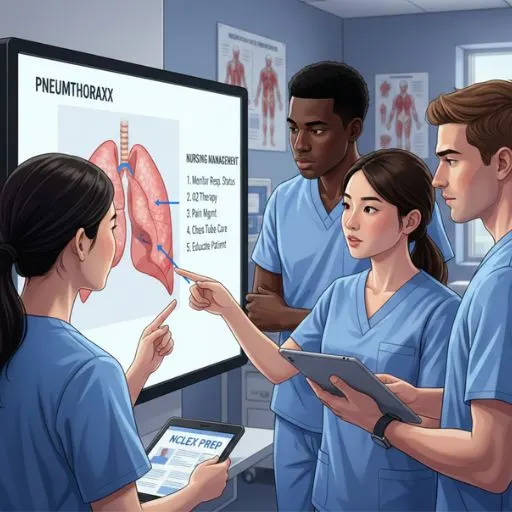
Pneumothorax is a high-yield respiratory emergency topic in the NCLEX-RN exam. Many students lose marks not because the concept is difficult, but because they miss priority nursing actions and clinical judgment cues. This guide explains pneumothorax nursing management in a clear, exam-focused way—just like how an experienced NCLEX trainer would teach in class.
What Is Pneumothorax?
Pneumothorax occurs when air enters the pleural space, causing partial or complete lung collapse. This reduces lung expansion and leads to impaired gas exchange.
In NCLEX questions, pneumothorax is often tested as:
- A post-procedure complication
- A trauma emergency
- A sudden respiratory deterioration case
Types of Pneumothorax You Must Recognize
NCLEX often expects you to identify the type before choosing the intervention.
- Spontaneous pneumothorax – common in tall, thin adults or patients with lung disease
- Traumatic pneumothorax – due to injury or invasive procedures
- Tension pneumothorax – life-threatening emergency (most tested)
👉 Exam tip: If the question mentions tracheal deviation, severe distress, hypotension, think tension pneumothorax and act immediately.
Key Assessment Findings (NCLEX Focus)
Before intervention, assessment clues guide your answer.
- Sudden chest pain
- Shortness of breath
- Decreased or absent breath sounds on one side
- Tachypnea and tachycardia
- Low oxygen saturation
- Cyanosis (late sign)
NCLEX usually asks: “What is the nurse’s priority action?”
Assessment comes first—unless it’s tension pneumothorax.
Pneumothorax Nursing Management (Step-by-Step)
1. Maintain Airway and Oxygenation
- Administer high-flow oxygen as prescribed
- Position patient in high Fowler’s to improve lung expansion
- Continuously monitor SpO₂
👉 Priority concept: Airway → Breathing → Circulation (ABC)
2. Prepare for Emergency Interventions
Depending on severity, management may include:
- Needle decompression (for tension pneumothorax)
- Chest tube insertion to remove air from pleural space
NCLEX favorite:
If a chest tube gets disconnected → place the tube in sterile water, not clamp it.
3. Chest Tube Nursing Care (Very High Yield)
- Ensure the drainage system is below chest level
- Check for continuous bubbling (may indicate air leak)
- Do not clamp the tube unless prescribed
- Assess insertion site for infection or subcutaneous emphysema
Many NCLEX questions are built around what not to do with chest tubes.
4. Ongoing Monitoring and Safety
- Monitor respiratory status and vital signs
- Assess for re-expansion pulmonary edema
- Provide pain control to promote deep breathing
- Encourage incentive spirometry if ordered
Common NCLEX Mistakes to Avoid
- Delaying oxygen administration
- Focusing on pain before breathing
- Clamping chest tubes unnecessarily
- Ignoring sudden respiratory deterioration
Why This Topic Matters for NCLEX Success
Pneumothorax questions often appear in:
- SATA (Select All That Apply)
- Clinical judgment case studies
- Priority and delegation questions
Strong understanding of pneumothorax nursing management improves performance in Next-Gen NCLEX scenarios.
NCLEX Preparation Support in Kerala
Students preparing through a NCLEX RN coaching centre in Kerala often receive focused training on emergency topics like pneumothorax because these areas carry high exam weightage.
If you are looking for a structured program in central Kerala, a NCLEX RN coaching centre in Kottayam can be ideal for in-depth clinical reasoning practice and mock exams.
One institute frequently mentioned by students for its exam-oriented teaching approach is Medline Academy, known for simplifying complex emergency nursing concepts into clear decision-making steps.
Final NCLEX Takeaway
In NCLEX:
- Recognize pneumothorax fast
- Prioritize airway and breathing
- Act immediately in tension pneumothorax
- Know chest tube do’s and don’ts
FREQUENTLY ASKED QUESTIONS
What is the nurse’s first priority in pneumothorax management?
The first priority is maintaining airway and breathing. Nurses should administer oxygen, assess respiratory status, and monitor oxygen saturation. In suspected tension pneumothorax, emergency intervention is required immediately.
What chest tube care points are important for NCLEX exams?
The drainage system must stay below chest level, bubbling should be monitored, and the tube should not be clamped unless prescribed. If disconnection occurs, the tube should be placed in sterile water.
How does NCLEX test pneumothorax nursing concepts?
NCLEX question types commonly test pneumothorax through priority, case studies, and SATA on assessment and chest tube care.
Where can students learn pneumothorax nursing management for NCLEX in Kerala?
Students often learn high-yield emergency nursing topics like pneumothorax in structured training programs offered by NCLEX RN coaching centres in Kerala and Kottayam, including Medline Academy.