
Table of Contents
ToggleA Comparative Guide to Nursing Interventions, Monitoring, and Safe Administration
Picture this: a patient walks into a hospital feeling dizzy. Two nurses check on them. One just asks “What’s wrong?” and writes down the answer. The other checks their pulse, looks at their skin color, asks about their medical history, and watches how they breathe, all before writing a single note.
Which nurse do you trust more?
That second nurse is doing something called a nursing process assessment. It’s the very first step of good nursing care, and it’s also one of the most tested topics on the NCLEX-RN exam. If you’re studying to become a Registered Nurse, especially if you’re dreaming of practicing abroad, this is a skill you cannot skip.
Let’s break it down in plain, simple language. No confusing medical jargon. Just what you really need to know.
What Is Nursing Process Assessment?
The assessment is the first and most crucial phase in the nursing process. It’s how a nurse collects information about a patient before deciding what care they need.
Think of it like being a detective. You gather clues about how the patient feels, what their body is telling you, what their medical history says, and use those clues to figure out what’s really going on.
This step happens before diagnosis, before planning, before any treatment. Get it wrong, and everything after it can go wrong too. Get it right, and you set the patient up for safe, accurate care.
Why Is Assessment the Foundation of the Nursing Process?
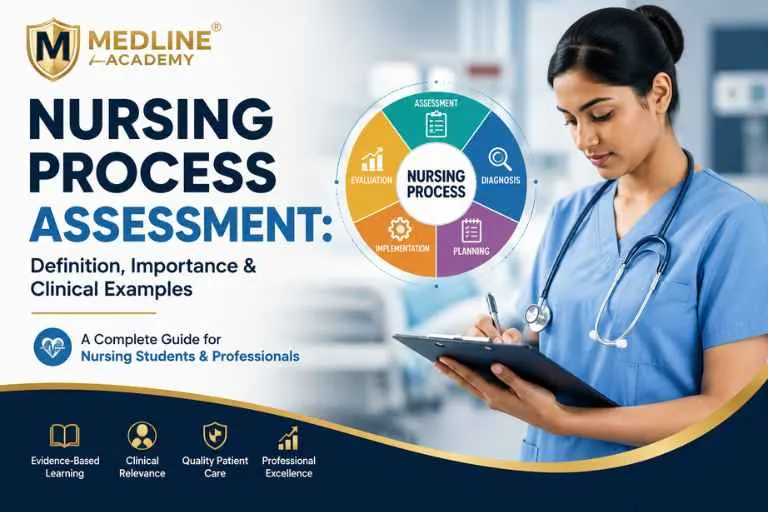
Assessment, Diagnosis, Planning, Implementation, and Evaluation are the five steps in the nursing process. Assessment comes first for a reason: it’s the foundation on which everything else is built.
Here’s why it matters so much:
- It prevents guesswork. Without proper assessment, a nurse is just guessing what’s wrong.
- It catches problems early. A missed symptom during assessment can turn into a bigger emergency later.
- It builds the patient’s full picture. A single symptom rarely conveys the entire message. Assessment connects the dots.
- It’s the most frequently tested ability on the NCLEX-RN. Examiners want to see if you can think like a nurse, not just memorize facts.
If the foundation is weak, the whole care plan is weak. Simple as that.
Objectives of Nursing Process Assessment
Every assessment a nurse performs should aim to:
- Collect accurate and complete patient information.
- Identify the patient’s current health problems and risks
- Understand the patient’s normal baseline (so changes can be spotted quickly)
- Support safe, evidence-based clinical decisions
- Create a starting point for the nursing diagnosis and care plan
Keep these five goals in mind, and assessment stops feeling like a checklist; it becomes a purpose-driven skill.
Types of Nursing Assessment
Not every assessment looks the same. The type depends on the situation.
Initial Assessment
Done when a patient is first admitted. It’s detailed and covers the patient’s full health history and current condition.
Focused Assessment
Done when a nurse needs to check one specific problem like a wound, a headache, or breathing trouble.
Emergency Assessment
Fast and urgent. Used when a patient’s life is at risk, like during a heart attack or severe injury. Speed matters more than detail here.
Comprehensive Assessment
A deep, full-body evaluation, often used for new patients or during annual check-ups. Covers physical, emotional, and social health.
Ongoing Assessment
Done regularly throughout a patient’s care to track progress and catch any new changes.
Knowing which type to use and when is exactly the kind of clinical judgment the NCLEX-RN tests for.
Steps Involved in Nursing Process Assessment
Here’s the step-by-step process every nurse should follow:
1. Collect Subjective Data
This is what the patient tells you: their symptoms, pain level, and feelings. Example: “My chest feels tight.”
2. Collect Objective Data
This is what you observe or measure: vital signs, test results, physical signs. Example: blood pressure reading of 150/95.
3. Review Medical History
Look at past illnesses, surgeries, allergies, and medications. History often explains today’s symptoms.
4. Perform a Physical Examination
A hands-on check, often head-to-toe, to spot anything unusual.
5. Document Findings
Write everything down clearly and accurately. Good documentation protects both the patient and the nurse.
6. Prioritize Patient Needs
Not every finding needs action right away. A nurse must decide what’s urgent and what can wait; this is where the ABC framework (Airway, Breathing, Circulation) comes in handy.
Clinical Example of Nursing Process Assessment
Let’s make this real.
A 58-year-old man is admitted complaining of shortness of breath and fatigue.
- Subjective data: He says he feels “out of breath” even while resting, and has felt “unusually tired” for three days.
- Objective data: Blood pressure is 148/92, heart rate is 102 bpm, oxygen saturation is 91%.
- Medical history: He has a history of high blood pressure and smokes a pack of cigarettes daily.
- Physical exam: Swelling is noted in both ankles. Breathing sounds are slightly crackly.
- Prioritization: Because his oxygen levels are low and his breathing is affected, the nurse flags this as urgent and alerts the physician immediately.
Notice how each piece of data adds to the picture. None of it means much alone together; it points toward a possible heart-related issue that needs quick attention.
Common Assessment Mistakes Nursing Students Should Avoid
Even good students slip up here. Watch out for these:
- Rushing the process. Skipping steps to “save time” often means missing something important.
- Mixing up subjective and objective data. “Patient says he feels feverish” is subjective. “Temperature is 101°F” is objective. Know the difference.
- Relying only on what the patient says. Some patients downplay symptoms. Objective data fills the gaps.
- Poor documentation. If it’s not written down clearly, it’s hard to prove it was done and harder for the next nurse to understand.
- Ignoring the patient’s baseline. A “normal” reading for one patient might be a red flag for another.
Avoiding these mistakes isn’t just good for your exam score; it’s good for real patients.
NCLEX Tips for Nursing Process Assessment
Assessment questions show up constantly on the NCLEX-RN. Here’s how to confidently deal with them:
- Use the ABC framework (Airway, Breathing, Circulation) to decide what to check or treat first.
- Look for safety first. If a question gives you multiple findings, ask: which one threatens the patient’s safety the most right now?
- Practice separating subjective vs. objective data; this shows up again and again.
- Think like a nurse, not a test-taker. NCLEX questions test clinical judgment, not memorization.
- Read the question twice. Many wrong answers come from missing one small detail in the scenario.
These aren’t just exam tricks; they’re the same instincts you’ll use on the job every single day.
Prepare for NCLEX with Expert Guidance
Reading about assessment is one thing. Practicing it under real exam conditions with expert feedback is another.
If you’re preparing for the NCLEX-RN and want to turn concepts like this into exam-ready confidence, Medline’s NCLEX RN Coaching can help you get there. Whether you’re based in Kochi, Trivandrum, or anywhere else in Kerala, Medline offers:
- Expert faculty with real clinical and coaching experience
- Classes in Malayalam to make difficult subjects easier to understand
- Structured mock tests that mirror the real exam pattern
- Personalized guidance to help you build clinical reasoning, not just memorize facts
- Both online and onsite training options
It’s not just about passing the test; passing the NCLEX-RN opens the door to practicing nursing overseas and pursuing the career you’ve fought so hard for. A good coaching partner can make that path a lot less overwhelming.
FREQUENTLY ASKED QUESTIONS
What are prioritization questions in the NCLEX?
What is the ABC approach in nursing?
Does the Next Generation NCLEX include prioritization questions?
Yes. Prioritization is a major component of the NGN and is often integrated into case studies and clinical judgment questions.
How can I improve my prioritization skills?
Practice NCLEX-style questions, review rationales carefully, focus on abnormal findings, apply ABC principles, and consistently prioritize patient safety.
What should I do if two patients seem equally sick?

Ainstin S Dennis, MSc (N) is the Founder and Director of Medline Academy®, a leading NCLEX-RN coaching institute in Kerala. With extensive experience in nursing education and NCLEX-RN preparation, he has mentored thousands of aspiring nurses through structured, concept-based training focused on clinical judgment and the Next Generation NCLEX (NGN). His articles provide practical insights, exam strategies, and up-to-date guidance to help nursing professionals prepare confidently for international nursing careers.