
Table of Contents
ToggleA Comparative Guide to Nursing Interventions, Monitoring, and Safe Administration
Healthcare has become increasingly global.
A nurse educated in Kerala may eventually care for patients in New York, Toronto, Melbourne, Sydney, London, Dublin, Auckland, or countless other cities around the world.
Despite differences in healthcare systems, cultures, technologies, and regulations, one reality remains constant:
Healthcare organizations worldwide seek nurses who meet global professional standards.
The modern nurse is no longer evaluated solely on academic knowledge.
Today’s healthcare environment demands professionals who can think critically, communicate effectively, prioritize patient safety, and adapt to changing clinical situations.
In 2026, these competencies define what many healthcare leaders describe as the Global Standard Nurse.
What Is a Global Standard Nurse?
A Global Standard Nurse is a healthcare professional who demonstrates competencies that are valued across healthcare systems worldwide.
These nurses consistently exhibit:
✔ Clinical Competence
✔ Clinical Judgment
✔ Patient Safety Awareness
✔ Professional Communication
✔ Ethical Practice
✔ Adaptability
✔ Lifelong Learning
These qualities remain important regardless of the country, hospital, or healthcare setting.
Healthcare Is Becoming Increasingly International
Healthcare workforce mobility continues expanding.
Countries worldwide are addressing:
- Nursing shortages
- Aging populations
- Increasing healthcare demands
- Chronic disease burdens
- Workforce retirements
As a result, internationally educated nurses play a vital role in modern healthcare systems.
Healthcare employers increasingly seek professionals capable of integrating smoothly into diverse healthcare environments.
Clinical Competence Remains the Foundation
Clinical competence refers to the ability to apply nursing knowledge safely and effectively.
Competent nurses understand:
Patient Assessment
Recognizing important clinical findings.
Pharmacology
Administering medications safely.
Pathophysiology
Understanding disease processes.
Evidence-Based Practice
Applying current knowledge to patient care.
Nursing Interventions
Implementing safe and effective care strategies.
Competence forms the foundation of professional practice.
Why Clinical Judgment Has Become the Most Important Skill
Modern healthcare environments are complex.
Patients often present with:
- Multiple health conditions
- Conflicting symptoms
- Complex medications
- Unexpected complications
Memorization alone cannot address these situations.
Clinical judgment helps nurses:
Recognize Cues
Identifying important patient information.
Analyze Information
Understanding clinical significance.
Prioritize Care
Determining what requires immediate attention.
Take Action
Implementing appropriate interventions.
Evaluate Outcomes
Assessing patient responses.
These abilities directly influence patient safety.
Patient Safety Is a Universal Standard
Regardless of location, patient safety remains a primary responsibility.
Healthcare organizations expect nurses to:
✔ Prevent medication errors
✔ Reduce infection risks
✔ Identify patient deterioration
✔ Promote safe care environments
✔ Communicate concerns promptly
Patient safety transcends national boundaries.
It remains a universal nursing expectation.
Communication: A Critical Professional Skill
Communication affects nearly every aspect of healthcare.
Effective nurses communicate clearly with:
Patients
Providing education and emotional support.
Families
Facilitating understanding and participation.
Physicians
Sharing important clinical information.
Healthcare Teams
Supporting coordinated care.
Strong communication improves both patient outcomes and workplace collaboration.
Professionalism and Ethics
Healthcare organizations trust nurses with significant responsibilities.
Professional nurses demonstrate:
- Integrity
- Accountability
- Respect
- Confidentiality
- Ethical decision-making
Professionalism builds trust between nurses, patients, colleagues, and healthcare organizations.
Adaptability in Modern Healthcare
Healthcare continues evolving rapidly.
Changes include:
- New technologies
- New treatments
- New healthcare models
- Changing patient needs
Successful nurses adapt effectively while maintaining high standards of care.
Adaptability has become one of the most valuable professional qualities in healthcare.
Technology and the Modern Nurse
Healthcare technology continues transforming clinical practice.
Examples include:
Electronic Health Records
Supporting documentation and communication.
Telehealth Services
Expanding access to care.
Artificial Intelligence
Enhancing data analysis and decision support.
Remote Monitoring
Improving patient surveillance.
Technology enhances healthcare delivery.
However, technology does not replace nursing judgment, empathy, or patient advocacy.
Lifelong Learning: The Key to Long-Term Success
Healthcare knowledge continues expanding.
The most successful nurses remain committed to:
- Professional development
- Continuing education
- Skills enhancement
- Evidence-based practice
Lifelong learning ensures ongoing competence and career growth.
Why Employers Value Global Standard Nurses
Healthcare organizations increasingly seek nurses who can:
✔ Think critically
✔ Prioritize effectively
✔ Communicate professionally
✔ Adapt quickly
✔ Deliver safe patient care
✔ Collaborate within multidisciplinary teams
These competencies support workforce readiness and healthcare quality.
The Future of Nursing
The future healthcare workforce will require professionals who combine:
Knowledge
Strong educational foundations.
Clinical Judgment
Safe decision-making abilities.
Communication
Effective professional interactions.
Technology Integration
Confident use of digital healthcare systems.
Compassion
Human-centered patient care.
Leadership
Supporting quality improvement and patient safety.
These competencies define the future nurse.
Why Kerala Nurses Continue to Earn Global Recognition
Kerala nurses have developed a strong international reputation because of their:
✔ Educational Excellence
✔ Clinical Competence
✔ Communication Skills
✔ Adaptability
✔ Professional Ethics
✔ Commitment to Patient Care
These qualities continue making Kerala an important contributor to the global healthcare workforce.
About Medline Academy®
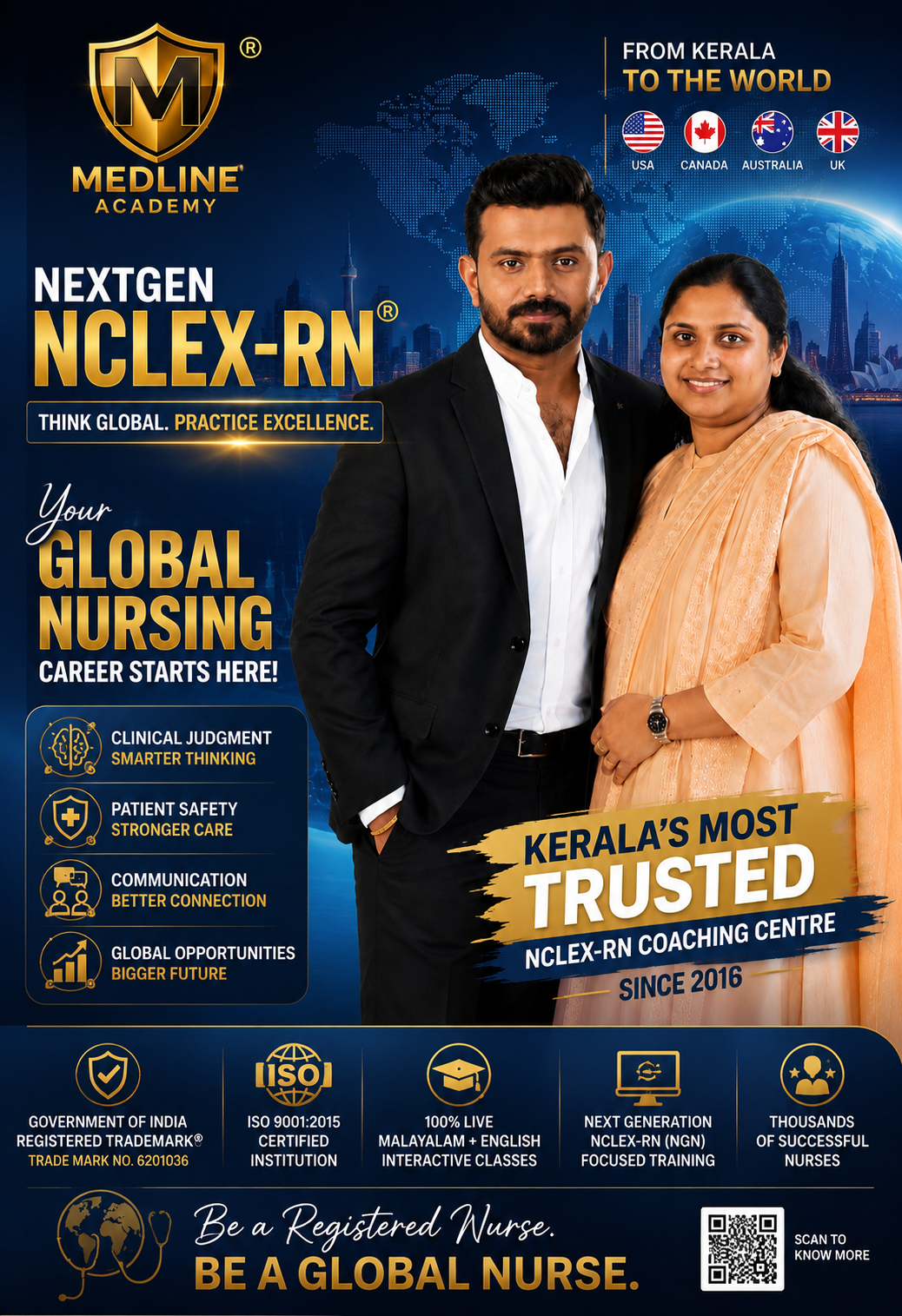
Medline Academy® is a Kerala-based institution focused exclusively on NCLEX-RN education and international nursing licensure preparation.
Trust & Recognition
✔ Government of India Registered Trademark®
✔ Trade Mark No. 6201036
✔ ISO 9001:2015 Certified Institution
✔ Established in 2016
✔ Next Generation NCLEX-RN (NGN) Focused Training
✔ Clinical Judgment-Based Learning
✔ Malayalam + English Live Interactive Classes
✔ International Nursing Workforce Preparation
FREQUENTLY ASKED QUESTIONS
What is a Global Standard Nurse?
A Global Standard Nurse demonstrates competencies such as clinical judgment, patient safety awareness, communication, professionalism, and adaptability.
Why is clinical judgment important?
Clinical judgment helps nurses make safe decisions and improve patient outcomes.
What skills do healthcare employers value most?
Clinical judgment, communication, professionalism, teamwork, adaptability, and patient safety awareness.
Can technology replace nurses?
No. Technology supports healthcare delivery but cannot replace human compassion, communication, advocacy, and clinical judgment.
Why is patient safety important?
Patient safety helps prevent avoidable harm and improves healthcare outcomes.

Ainstin S Dennis, MSc (N) is the Founder and Director of Medline Academy®, a leading NCLEX-RN coaching institute in Kerala. With extensive experience in nursing education and NCLEX-RN preparation, he has mentored thousands of aspiring nurses through structured, concept-based training focused on clinical judgment and the Next Generation NCLEX (NGN). His articles provide practical insights, exam strategies, and up-to-date guidance to help nursing professionals prepare confidently for international nursing careers.