
Table of Contents
ToggleA Comparative Guide to Nursing Interventions, Monitoring, and Safe Administration
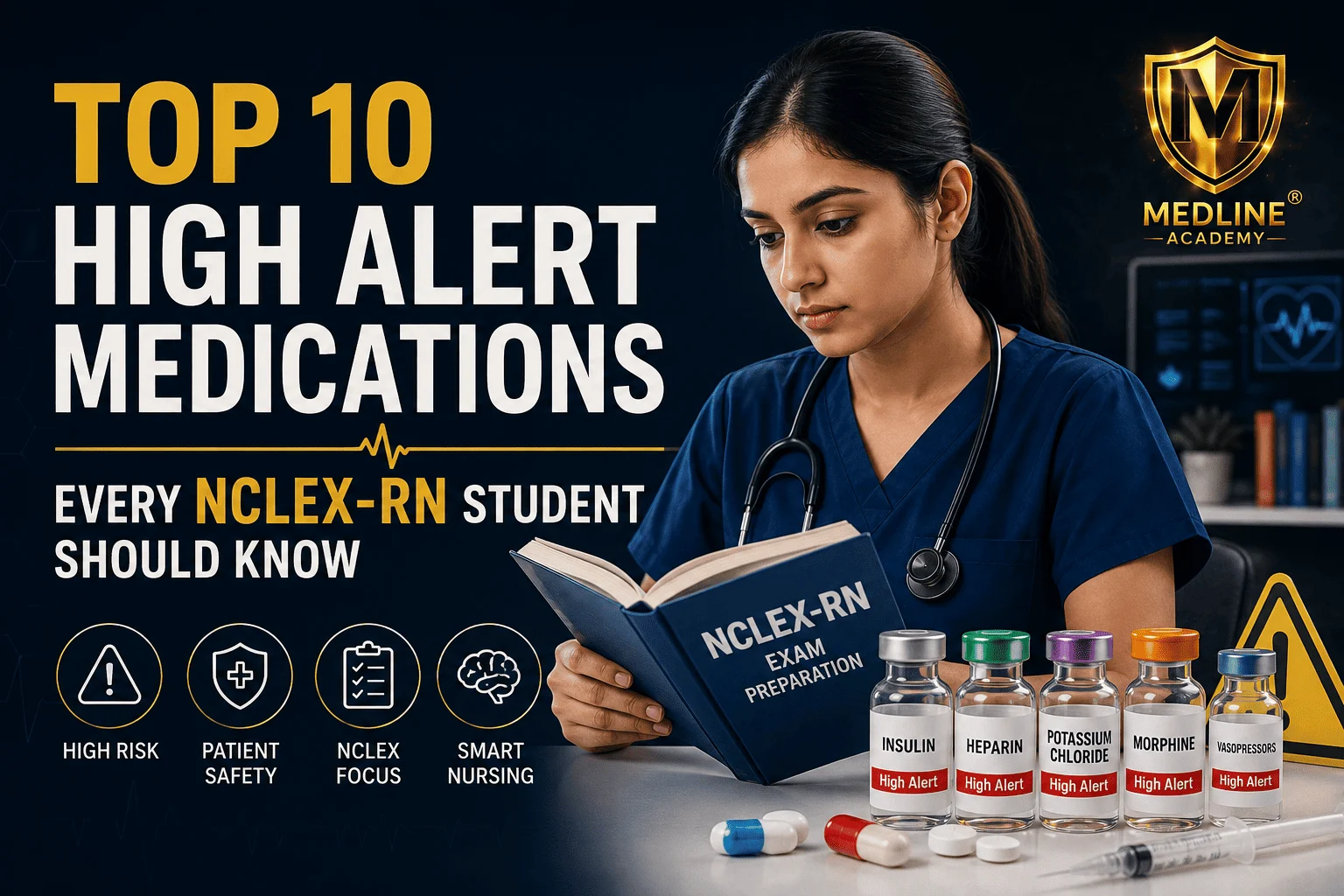
Preparing for the NCLEX-RN can feel overwhelming, especially when you reach pharmacology. With hundreds of medications to study, it’s easy to wonder which ones deserve the most attention. The good news is that not every drug carries the same level of risk.
Some medications require extra caution because even a small mistake in the dose, route, or timing can lead to serious harm. These are known as High Alert Medications, and they are one of the most critical issues that all nursing students should be aware of.
Whether you’re preparing for your first NCLEX-RN attempt or planning a retake, mastering these medications will not only improve your exam performance but also help you become a safer and more confident nurse. In this guide, we’ll explain the top 10 high-alert medications every NCLEX-RN student should know, along with practical nursing responsibilities and simple study tips to help you remember them.
What Are High Alert Medications?
High Alert Medications are drugs that have a greater risk of causing serious patient harm if they are given incorrectly. This doesn’t mean they are dangerous medicines. It simply means that nurses must handle them with extra care because even a small medication error can have severe consequences.
Organizations such as the Institute for Safe Medication Practices (ISMP) identify these medications to help healthcare professionals improve medication safety and reduce preventable errors. Hospitals also have strict protocols for storing, preparing, and administering these drugs.
For NCLEX-RN students, these medications are especially important because they test much more than memorization. The exam often checks whether you can apply clinical judgment, recognize potential risks, calculate the correct dose, and choose the safest nursing intervention.
Why Do High Alert Medications Matter in Nursing Practice
One of a registered nurse’s most significant duties is administering medication. Every dose you give has the potential to improve a patient’s condition—or cause harm if administered incorrectly.
High alert medications require careful assessment before, during, and after administration. As a nurse, you must verify the medication order, calculate the correct dosage, monitor the patient’s response, and identify early signs of adverse reactions.
NCLEX-RN pharmacology places a lot of emphasis on these drugs since they incorporate a number of crucial nursing competencies, such as:
- Safe medication administration
- Clinical judgment
- Nursing drug calculations
- Patient monitoring
- Recognizing adverse drug reactions
- Patient education
The more comfortable you become with these concepts, the easier pharmacology questions will feel during the NCLEX-RN exam.
If you’re finding pharmacology challenging, learning through structured lessons and regular practice questions can make a big difference. At Medline Academy, students receive expert guidance, simplified pharmacology sessions, and realistic NCLEX-style practice that helps build confidence one concept at a time.
Top 10 High Alert Medications Every NCLEX-RN Student Should Know
1. Insulin
Insulin is one of the most commonly tested high-alert medications in the NCLEX-RN. It controls blood glucose levels, but the wrong type or dose can cause severe hypoglycemia.
Nursing Responsibilities
- Check blood glucose before administration.
- Verify the correct insulin type and dose.
- Confirm meal timing.
- Monitor for signs of hypoglycemia.
NCLEX Tip: Always think, “Check the blood sugar first.”
2. Heparin
One anticoagulant used to stop blood clots is heparin. As a high-risk medication in nursing, incorrect use can lead to serious bleeding.
Nursing Responsibilities
- Assess for bleeding or bruising.
- Monitor prescribed laboratory values.
- Avoid massaging the injection site.
- Educate patients to report unusual bleeding.
NCLEX Tip: Know the differences between heparin and warfarin.
3. Warfarin
The long-term prevention of blood clots is the purpose of warfarin. Because it increases the risk of bleeding, careful monitoring and patient education are essential.
Nursing Responsibilities
- Monitor INR as prescribed.
- Watch for signs of bleeding.
- Teach patients about food and drug interactions.
NCLEX Tip: Remember Vitamin K is associated with warfarin.
4. Potassium Chloride (KCl)
Potassium chloride treats low potassium levels but can cause life-threatening heart problems if administered incorrectly.
Nursing Responsibilities
- Check potassium levels before administration.
- Dilute IV potassium properly.
- Monitor cardiac rhythm when needed.
- Potassium should never be administered as a quick IV push.
NCLEX Tip: Rapid IV push potassium is never safe.
5. Morphine
Morphine is a strong opioid used for severe pain. Its biggest risk is respiratory depression, making patient monitoring essential.
Nursing Responsibilities
- Assess pain before administration.
- Monitor respiratory rate, blood pressure, and oxygen saturation.
- Reassess pain after giving the medication.
NCLEX Tip: Check the respiratory rate before administering morphine.
6. Epinephrine
Epinephrine is a high-alert medication used for anaphylaxis, cardiac arrest, and other emergencies. Correct dosing is critical.
Nursing Responsibilities
- Verify the correct dose and concentration.
- Monitor heart rate and blood pressure.
- Assess airway, breathing, and circulation.
NCLEX Tip: Epinephrine is the first-line treatment for anaphylaxis.
7. Digoxin
Digoxin treats heart failure and certain heart rhythm disorders. Because it has a narrow therapeutic range, close monitoring is required.
Nursing Responsibilities
- Check the apical pulse before administration.
- Monitor for digoxin toxicity.
- Review potassium levels.
NCLEX Tip: Always assess the apical pulse before giving digoxin.
8. Magnesium Sulfate
Magnesium sulfate is commonly used to prevent seizures in severe preeclampsia and treat certain electrolyte disorders.
Nursing Responsibilities
- Monitor respiratory rate.
- Check deep tendon reflexes.
- Monitor urine output.
- Watch for magnesium toxicity.
NCLEX Tip: Loss of deep tendon reflexes may indicate magnesium toxicity.
9. Fentanyl
Fentanyl is a powerful opioid used for severe pain. Because it can cause respiratory depression, close monitoring is essential.
Nursing Responsibilities
- Assess pain and respiratory status.
- Monitor oxygen saturation.
- Observe the patient’s level of consciousness.
NCLEX Tip: Always assess airway and breathing before administering opioids.
10. Norepinephrine
Norepinephrine treats severe hypotension and septic shock by increasing blood pressure. During IV infusion, it has to be continuously monitored.
Nursing Responsibilities
- Monitor blood pressure continuously.
- Assess the IV site regularly.
- Watch for reduced blood flow to the extremities.
NCLEX Tip: Focus on continuous patient monitoring and IV medication safety in NCLEX-RN questions.
Common Medication Errors Nursing Students Should Avoid
One of the main ways that patients might be harmed is through medication mistakes. Even experienced nurses carefully follow safety protocols before giving every medication.
Some of the most common errors include:
- Giving medication to the wrong patient.
- Administering the wrong medication.
- Giving the wrong dose.
- Using the wrong route.
- Giving medication at the wrong time.
- Forgetting to document administration.
Many of these mistakes can be prevented by slowing down, verifying every medication order, and following your organization’s medication safety policies.
The Five Rights of Medication Administration
Every nursing student learns the Five Rights of Medication Administration, and for good reason. These five checks form the foundation of safe nursing practice.
Always verify:
- Right Patient
- Right Drug
- Right Dose
- Right Route
- Right Time
Today, many healthcare organizations also encourage nurses to follow additional safety principles, including:
- Right documentation
- Right reason
- Right response
- Right patient education
Following these checks helps reduce medication errors and improves patient safety in every healthcare setting.
NCLEX-RN Pharmacology Tips for Remembering High-Alert Medications
Pharmacology becomes much easier when you study consistently instead of trying to memorize everything at once.
Here are a few simple strategies that work well for many nursing students:
Learn medications by drug class
Instead of studying one medication at a time, group similar drugs together. Their activities and side effects are easier to recall as a result.
Practice NCLEX-style questions daily
Answering practice questions helps you apply your knowledge and recognize common exam patterns.
Use flashcards
Create flashcards with the drug name, purpose, major side effects, and nursing considerations.
Try mnemonics
Memory tricks make it easier to recall important information during the exam.
Revise a little every day
Even 20 to 30 minutes of daily revision can improve long-term memory and reduce exam stress.
If you’re looking for a structured study plan, Medline Academy’s NCLEX-RN Preparation Course combines pharmacology classes, medication calculation practice, clinical guidance, and mock exams to help students prepare with confidence.
Final Thoughts
Mastering High Alert Medications is an important step toward NCLEX-RN success and safe nursing practice. Instead of simply memorizing drug names, focus on their uses, side effects, and nursing responsibilities to strengthen your clinical judgment.
At Medline Academy, our expert-led NCLEX-RN coaching, pharmacology training, and realistic practice sessions help aspiring nurses build the knowledge and confidence needed to succeed in the exam and their future nursing careers.
FREQUENTLY ASKED QUESTIONS
What are High Alert Medications?
High Alert medications are those that, if used improperly, have a greater potential to cause major damage. They require extra care during medication administration.
Which high-alert medications are commonly tested on the NCLEX-RN?
Insulin, heparin, warfarin, potassium chloride, morphine, epinephrine, digoxin, magnesium sulphate, fentanyl, and norepinephrine are often tested high-alert drugs.
Why is insulin considered a high-alert medication?
Insulin is a high-alert medication because even a small dosing error can cause dangerous changes in blood glucose levels.
How can nursing students improve their pharmacology skills?
Practice NCLEX-RN questions, use flashcards, study drug classes, and revise regularly to strengthen NCLEX-RN pharmacology knowledge.
What do the Five Rights of Medication Administration mean?
The Five Rights of Medication Administration are Right Patient, Right Drug, Right Dose, Right Route, and Right Time. These checks help improve medication safety.

Ainstin S Dennis, MSc (N) is the Founder and Director of Medline Academy®, a leading NCLEX-RN coaching institute in Kerala. With extensive experience in nursing education and NCLEX-RN preparation, he has mentored thousands of aspiring nurses through structured, concept-based training focused on clinical judgment and the Next Generation NCLEX (NGN). His articles provide practical insights, exam strategies, and up-to-date guidance to help nursing professionals prepare confidently for international nursing careers.