
Table of Contents
ToggleA Comparative Guide to Nursing Interventions, Monitoring, and Safe Administration
A patient develops sudden shortness of breath after surgery, with falling oxygen saturation, a rising heart rate, and anxiety. These are major warning signs of pulmonary embolism (PE), a life-threatening complication of venous thromboembolism.
For the NCLEX-RN, understanding venous thromboembolism nursing interventions means recognizing risk factors, identifying DVT and PE signs, and prioritizing care using the ABCs. This guide covers Virchow’s Triad, DVT, PE, hypercoagulability, anticoagulant safety, and priority nursing care.
What Is Venous Thromboembolism?
Venous thromboembolism (VTE) refers to blood clots that develop in the venous system. The two main types are:
- Deep Vein Thrombosis (DVT): A clot forms in a deep vein, commonly in the leg.
- Pulmonary Embolism (PE): Part of a clot breaks away and travels to the lungs, blocking pulmonary blood flow.
DVT and PE are closely related. A DVT can become dangerous when part of the clot travels to the lungs.
For the NCLEX-RN, VTE questions often involve postoperative patients, prolonged immobility, cancer, pregnancy, estrogen therapy, previous VTE, inherited clotting disorders, nephrotic syndrome, and anticoagulant therapy.
NCLEX pattern: Risk factor → DVT → possible PE → ABC priority
1. Virchow’s Triad: The Foundation of VTE
Virchow’s Triad describes three major factors that contribute to thrombus formation:
Component | Meaning | NCLEX Examples |
Venous stasis | Slowed blood flow | Immobility, bed rest, paralysis |
Endothelial injury | Damage to the vessel wall | Surgery, trauma, fractures |
Hypercoagulability | Increased tendency to clot | Cancer, pregnancy, estrogen therapy, inherited disorders |
Easy NCLEX Memory Trick
Think S-I-C:
- S = Stasis
- I = Injury
- C = Coagulation tendency
If a patient has several of these factors, think increased VTE risk.
2. Hypercoagulability and VTE Risk
Hypercoagulability means the blood has an increased tendency to form clots. It may be inherited or acquired.
Important examples include:
- Factor V Leiden
- Antithrombin deficiency
- Protein C or S deficiency
- Cancer
- Pregnancy
- Estrogen therapy
- Certain systemic conditions
Antithrombin III and Thromboembolism
Antithrombin is a natural anticoagulant that helps limit clot formation. Reduced antithrombin activity can contribute to a hypercoagulable state.
This is especially relevant to nephrotic syndrome, where significant protein loss through the kidneys can contribute to loss of anticoagulant proteins and increased VTE risk.
NCLEX Pearl:
Nephrotic syndrome + heavy proteinuria + low albumin + clotting signs = think hypercoagulability and increased VTE risk.
3. DVT NCLEX-RN: Recognizing the Signs
DVT commonly affects a deep vein in the lower extremity.
Assess for:
- Unilateral leg swelling
- Calf pain or tenderness
- Warmth
- Redness or discoloration
- Increased calf circumference
- New symptoms in a patient with VTE risk factors
Do Not Rely on Homan’s Sign
Homan’s sign refers to calf pain with passive dorsiflexion of the foot. It is not a reliable diagnostic test for DVT.
Instead, focus on comparing both extremities and assessing swelling, warmth, tenderness, skin changes, and circumference when indicated.
NCLEX Tip:
A postoperative patient with unilateral calf swelling and tenderness should be assessed for possible DVT rather than having the symptoms dismissed as routine postoperative discomfort.
4. Pulmonary Embolism NCLEX-RN: Red Flags
A pulmonary embolism occurs when a thrombus travels to the pulmonary circulation and obstructs blood flow. PE can rapidly become life-threatening.
Major PE Red Flags
Watch for:
- Sudden shortness of breath
- Tachypnea
- Tachycardia
- Pleuritic chest pain
- Decreased oxygen saturation
- Anxiety or a sense of impending doom
- Cough
- Hemoptysis
- Dizziness or syncope
- Hypotension in severe cases
High-Yield NCLEX Clue:
Recent surgery + immobility + sudden dyspnea = suspect PE.
When PE is suspected, do not delay priority care with a lengthy routine assessment. Focus on airway, breathing, oxygenation, and circulation.
5. DVT vs Pulmonary Embolism
Finding | DVT | PE |
Unilateral leg swelling | Common | May occur if DVT is present |
Leg pain/tenderness | Common | May occur |
Warmth/redness | Possible | Not a primary finding |
Sudden dyspnea | No | Major red flag |
Tachypnea | Not typical | Common |
Tachycardia | Possible | Common |
Pleuritic chest pain | No | Common |
Hemoptysis | No | Possible |
Syncope | No | Possible |
Hypotension | Not typical | Possible in severe PE |
Remember:
DVT = a clot in the vein.
PE = a clot affecting the lungs and circulation.
6. Venous Thromboembolism Nursing Interventions for Suspected DVT
When DVT is suspected, the nurse should recognize the problem, prevent complications, and follow the prescribed diagnostic and treatment plan.
Assess the affected extremity
Compare both legs for:
- Swelling
- Color
- Temperature
- Tenderness
- Circumference
Document and report significant changes.
Do not massage the affected limb
Never choose massage for a suspected DVT. It is not an appropriate intervention.
Follow activity orders
Do not automatically assume that every patient with DVT requires prolonged strict bed rest. Activity depends on the patient’s condition, treatment status, provider orders, and institutional protocols.
Use compression devices appropriately
Sequential compression devices (SCDs) are primarily used for VTE prevention in appropriate patients. They should not automatically be applied to an extremity with suspected or confirmed DVT without following the treatment plan and facility protocol.
Prepare for diagnostic evaluation
Depending on the circumstances, the patient may need:
- Venous duplex ultrasound
- Laboratory testing
- Additional diagnostic studies
NCLEX sequence:
Recognize → Report → Protect → Prepare
7. Emergency Nursing Interventions for Suspected PE
Suspected PE changes the priority because the patient may have an immediate threat to oxygenation and circulation.
1. Assess airway and breathing
Assess:
- Airway
- Respiratory rate
- Work of breathing
- Oxygen saturation
- Lung sounds
- Mental status
2. Position the patient
Unless contraindicated, use a position that promotes lung expansion, such as semi-Fowler’s or Fowler’s position.
3. Administer oxygen as indicated
Provide supplemental oxygen according to the patient’s oxygenation status and clinical protocol.
4. Monitor vital signs
Closely monitor:
- SpO₂
- Heart rate
- Blood pressure
- Respiratory rate
- Level of consciousness
Watch for hypotension, severe tachycardia, altered mental status, or syncope.
5. Escalate care
Notify the provider and activate emergency or rapid-response support when indicated. Prepare for diagnostic testing and treatment as ordered.
NCLEX Priority:
If the options include documenting history, reassessing pain, assessing the calf, or addressing severe respiratory distress, prioritize the ABC threat.
8. Anticoagulation Safety
Anticoagulants are commonly used to prevent or treat VTE. NCLEX questions may test medications, monitoring, adverse effects, and reversal agents.
Unfractionated Heparin
Important nursing considerations include:
- Monitor the appropriate coagulation test according to protocol.
- Monitor for bleeding.
- Monitor platelet counts.
- Watch for heparin-induced thrombocytopenia (HIT).
Reversal agent: Protamine sulfate.
Warfarin
Warfarin is an oral anticoagulant that requires INR monitoring.
A commonly used therapeutic INR range for VTE treatment is 2.0–3.0.
Reversal agent: Vitamin K.
Bleeding Precautions
Monitor for:
- Hematuria
- Melena
- Hematemesis
- Epistaxis
- Unusual bruising
- Prolonged bleeding
- Neurological changes
- Falling hemoglobin or hematocrit
9. Heparin-Induced Thrombocytopenia
HIT is a serious complication associated with heparin exposure.
The key NCLEX concept is:
HIT causes thrombocytopenia but can cause thrombosis.
A significant platelet decrease after heparin exposure, especially with new thrombosis, should raise concern for HIT.
Do not assume low platelets only mean increased bleeding risk. With HIT, new clot formation is a major concern.
Follow the appropriate protocol, notify the healthcare team, and prepare for alternative anticoagulation as ordered.
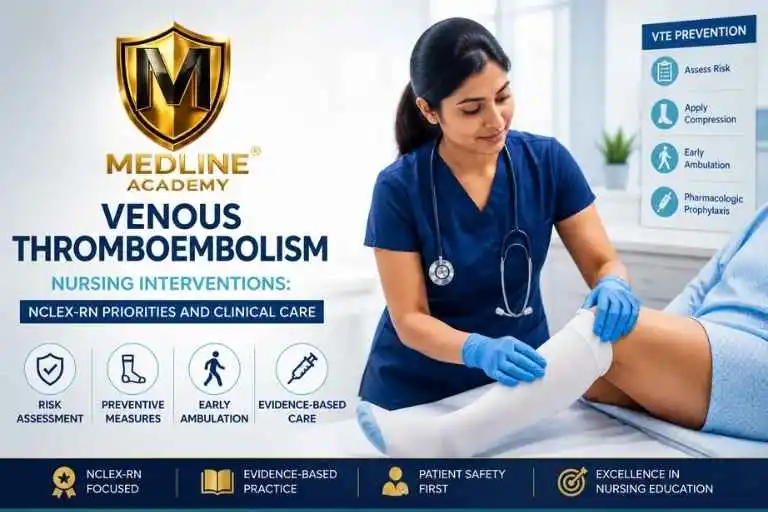
10. VTE Prevention
Preventing VTE is an important nursing responsibility.
Based on the patient’s health and orders, prevention can consist of:
- Early and appropriate ambulation
- Leg exercises
- Avoiding prolonged immobility
- Adequate hydration when appropriate
- SCDs for appropriate patients
- Prescribed pharmacologic prophylaxis
- Patient education
Think Prevention Before Complication
For an appropriate patient without an active DVT, SCDs can help reduce venous stasis.
For suspected or confirmed DVT, do not automatically apply SCDs to the affected extremity. Follow the prescribed plan and institutional protocol.
11. How to Answer Thromboembolism NCLEX Questions
Use this four-step approach:
Step 1: Identify the risk
Look for surgery, immobility, cancer, pregnancy, estrogen therapy, previous VTE, trauma, or hypercoagulable conditions.
Step 2: Identify DVT or PE
DVT: Unilateral swelling, pain, warmth, and redness.
PE: Sudden dyspnea, tachypnea, chest pain, tachycardia, hypoxemia, hemoptysis, or syncope.
Step 3: Determine the immediate threat
Ask:
Is the patient breathing adequately?
If acute respiratory distress is present, oxygenation and circulation become the priority.
Step 4: Choose the safest action
For suspected DVT:
Do not massage the leg.
For suspected PE:
Prioritize ABCs and urgent escalation.
For anticoagulants:
Think monitoring + bleeding + medication safety.
12. NGN Clinical Judgment Example
A 68-year-old patient is recovering from hip surgery and has been mostly immobile for three days. The nurse notices unilateral calf swelling and warmth. Later, the patient suddenly develops shortness of breath, tachycardia, and pleuritic chest pain.
What should the nurse recognize?
The patient has multiple VTE risk factors:
- Major surgery
- Immobility
- Older age
The initial findings suggest possible DVT. The sudden respiratory symptoms now raise concern for PE.
What is the priority?
The nurse should prioritize:
- Airway and breathing assessment
- Oxygenation
- Vital-sign monitoring
- Immediate escalation of care
- Preparation for diagnostic and therapeutic interventions
This reflects the clinical judgment approach tested by the Next Generation NCLEX.
13. Common VTE NCLEX Mistakes
Mistake 1: Choosing Homan’s sign
It is not a reliable diagnostic method for DVT.
Mistake 2: Massaging a painful calf
Do not massage a suspected DVT.
Mistake 3: Assuming every DVT requires strict bed rest
Activity should be based on the patient’s clinical condition and treatment plan.
Mistake 4: Applying SCDs without considering the diagnosis
SCDs are primarily preventive and should be used according to the patient’s clinical situation and orders.
Mistake 5: Focusing on the leg when the patient cannot breathe
When PE is suspected, ABCs come first.
Mistake 6: Forgetting anticoagulant safety
Remember monitoring, bleeding, platelet counts, HIT, and reversal agents.
14. Quick VTE NCLEX-RN Cheat Sheet
NCLEX Concept | Remember |
Virchow’s Triad | Stasis + endothelial injury + hypercoagulability |
DVT | Unilateral swelling, warmth, pain/tenderness |
PE | Sudden dyspnea, tachypnea, chest pain, tachycardia |
Homan’s sign | Do not rely on it |
Suspected DVT | Do not massage |
Suspected PE | ABCs and urgent escalation |
Heparin | Monitor therapy, bleeding, and platelets |
Heparin antidote | Protamine sulfate |
Warfarin | Monitor INR |
Warfarin antidote | Vitamin K |
HIT | Thrombocytopenia + thrombosis risk |
VTE prevention | Mobility, appropriate mechanical and pharmacologic prophylaxis |
Preparing for Thromboembolism NCLEX Questions
VTE questions are not simply about memorizing facts. They test whether you can connect risk factors, assessment findings, pathophysiology, and priority nursing interventions.
When practicing thromboembolism NCLEX questions, ask:
- What puts this patient at risk?
- Does the patient have DVT or PE findings?
- What is the immediate threat?
- Which intervention is safest?
If you are preparing for the NCLEX-RN and need structured support with clinical judgment, case studies, and practice questions, explore Medline, the best NCLEX RN coaching centre in Kerala.
Conclusion
Understanding venous thromboembolism nursing interventions starts with Virchow’s Triad and recognizing the key differences between DVT and PE.
For the NCLEX-RN, remember: unilateral swelling may indicate DVT, while sudden dyspnea, chest pain, tachycardia, or hypoxemia may indicate PE. Avoid relying on Homan’s sign or massaging a suspected DVT.
Use clinical reasoning to identify the risk, recognize the complication, and choose the safest priority action.
FREQUENTLY ASKED QUESTIONS
What is the priority nursing intervention for suspected PE?
The priority is to support airway, breathing, and oxygenation. Urgently escalate care and monitor the patient’s vital signs.
What are common signs of DVT?
Common symptoms include unilateral leg swelling, discomfort or tenderness, warmth, and redness. The affected leg may also have increased circumference.
What are common signs of DVT?
Common symptoms include unilateral leg swelling, discomfort or tenderness, warmth, and redness. The affected leg may also have increased circumference.
Should a nurse massage a leg with suspected DVT?
No, the nurse should not massage the affected leg. The patient requires appropriate assessment and medical evaluation.
Is Homan's sign reliable for DVT?
No, Homan’s sign is not a reliable diagnostic test for DVT. Nurses should assess other clinical findings and follow the diagnostic plan.
What's the key difference between DVT and PE?
DVT is a clot in a deep vein, usually in the leg. PE occurs when a clot travels to the lungs and obstructs pulmonary circulation.

Ainstin S Dennis, MSc (N) is the Founder and Director of Medline Academy®, a leading NCLEX-RN coaching institute in Kerala. With extensive experience in nursing education and NCLEX-RN preparation, he has mentored thousands of aspiring nurses through structured, concept-based training focused on clinical judgment and the Next Generation NCLEX (NGN). His articles provide practical insights, exam strategies, and up-to-date guidance to help nursing professionals prepare confidently for international nursing careers.